
Compliance Dashboard
Aug 05, 2026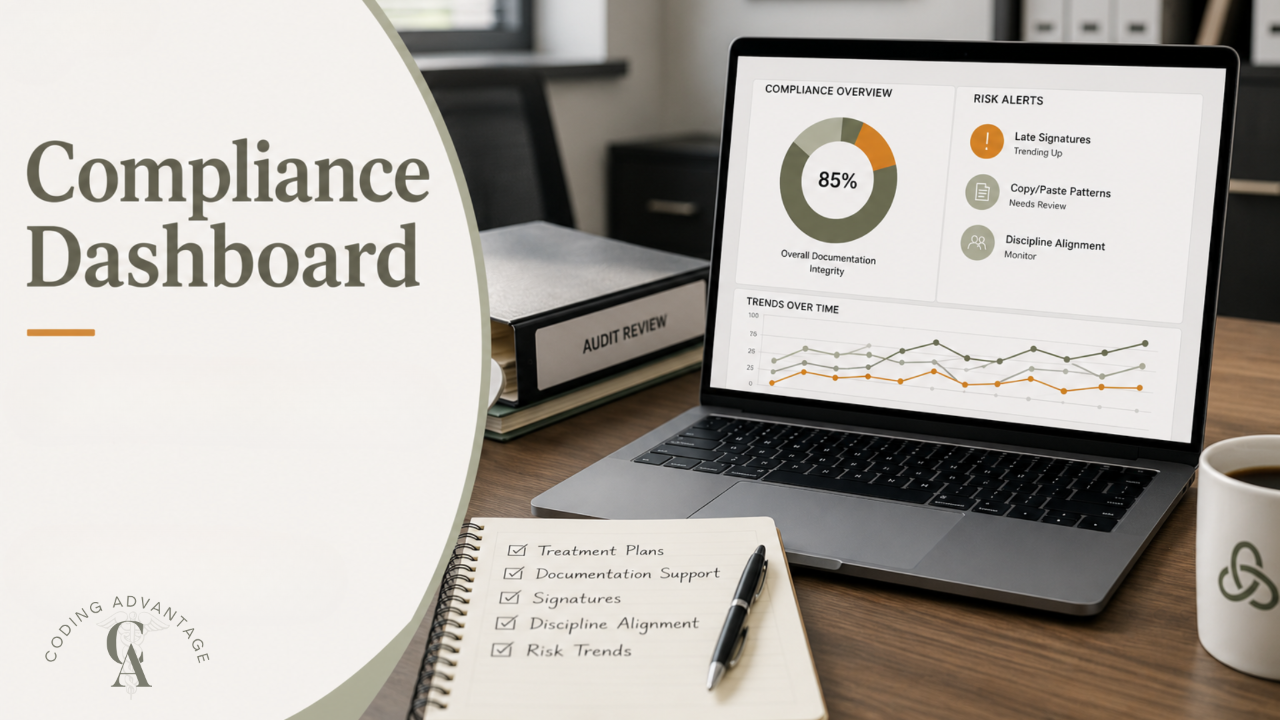
You are Measuring Revenue. Who's Measuring the Risk Behind It?
Behavioral health leadership teams spend a great deal of time reviewing dashboards, and they should. Census, revenue, productivity, staffing, scheduling, and access all matter. Without patients in programs and services being delivered, there is no organization to protect. The problem is not that leadership is measuring these things. The problem is that many organizations stop there.
While everyone is focused on keeping beds filled, appointments scheduled, providers productive, and revenue moving, documentation risk can quietly grow behind the scenes. That risk often remains invisible until a payer makes it impossible to ignore through a pre-payment review, a post-payment audit, a large medical record request, or a demand for repayment.
Once that happens, the organization is immediately placed into reaction mode. Leadership wants to understand what occurred, providers are asked to explain documentation from months, perhaps even years ago, compliance begins pulling records, and operational teams try to keep the organization functioning while also responding to the payer. The audit did not create the problem. It exposed a problem that may have been developing for months or even years.
One of the biggest challenges I see in behavioral health is not that leaders do not care about compliance. It is that they are measuring operational success without also measuring whether that success can withstand documentation scrutiny.
My clients have heard me say this so many times they could probably finish the sentence for me:
"Revenue without revenue integrity is just temporary success."
I usually get a smile the first time I say it. But when an organization finds itself responding to a pre-payment review or defending a post-payment audit, that statement suddenly carries a lot more weight.
Organizations celebrate visits completed, admissions, services billed, and revenue generated. Those are important accomplishments, but they do not answer the question leadership really needs to ask.
Could we defend that revenue if someone requested the records tomorrow?
That question changes the conversation because it moves compliance out of the category of something reviewed after a problem occurs and places it where it belongs, as part of ongoing leadership oversight.
The Missing View Behind the Numbers
A compliance dashboard should not be another spreadsheet filled with percentages that no one knows how to use. It should serve as an early warning system that helps leadership recognize patterns while there is still time to correct them.
The purpose is not simply to report that treatment plans were missing, signatures were late, documentation was copied, or services lacked adequate support. The purpose is to help leadership understand whether the organization is improving, whether the same problems continue to appear, and whether workflow, education, supervision, or accountability needs to change.
Most organizations are already measuring a tremendous amount of activity. What is often missing is the measurement of risk behind that activity.
|
What Leadership Commonly Measures |
What Leadership Should Also Measure |
|
Census and program capacity |
Whether treatment plans are current and connected to services |
|
Revenue and collections |
Whether documentation supports the services billed |
|
Provider productivity |
Whether records support continued treatment and medical necessity |
|
Admissions and discharges |
Whether the documented level of care is supported |
|
Staffing and scheduling |
Whether documentation trends are improving or worsening |
|
Program growth |
Whether all disciplines are telling the same patient story |
The point is not to replace operational reporting. Census and revenue still matter. The point is to stop treating those numbers as though they tell the entire story of organizational performance.
Are All Disciplines Telling the Same Patient Story?
One of the most important risks a dashboard can help uncover is the lack of connection among disciplines.
The nurse documents one presentation. The physician documents another. The clinician focuses on something entirely different, and the treatment plan does not clearly connect to any of it. Each individual note may contain a great deal of information, but when the record is viewed as a whole, it can look as though the professionals are working for different organizations and treating different patients.
This becomes especially concerning in substance use disorder services when the documentation does not consistently support the ASAM level of care. It is equally important in mental health services when the record does not clearly demonstrate why continued treatment is needed or how the services being delivered relate to the problems identified in the treatment plan.
Leadership does not need to read every record to understand whether this is happening. They do need a way to see whether the organization is consistently telling a clear, connected, and defensible patient story.
The Questions Leadership Should Be Asking
A useful compliance dashboard should help leadership answer a small number of important questions.
- Can we support the services we are billing?
- Does the documentation support the level and intensity of care being provided?
- Are treatment plans active, meaningful, and connected to the services documented?
- Are all disciplines working from the same clinical story?
- Are our documentation risks improving, remaining the same, or getting worse?
These questions are more useful than presenting leadership with isolated audit percentages. A finding of 18 percent late signatures means very little by itself. Leadership needs to know whether that rate is increasing, whether it is concentrated among a few providers or programs, what is causing the issue, and what is being done to correct it.
Every metric should lead to action. That action may involve reviewing a sample of records, evaluating a workflow, clarifying a documentation requirement, providing focused education, addressing accountability, or repeating an audit after corrective action has been implemented.
If the dashboard does not help someone decide what happens next, it is simply collecting data.
The Executive Dashboard and the Compliance Dashboard Are Not the Same
The compliance team may need detailed information by program, payer, service, code, provider type, or documentation requirement. Leadership does not need all of that detail during every meeting.
The executive dashboard should remain simple enough to review on one page. It should use clear trends and visual indicators to show where risk is increasing, where improvement is occurring, and where leadership attention is needed. Specific provider information should generally remain within the compliance or management process unless the individuals reviewing the dashboard have a reason and responsibility to know it.
Leadership needs the pattern, the impact, and the action. The compliance team needs the detail required to investigate and correct the pattern.
Confusing those two purposes is one reason dashboards become unusable. Either leadership receives so much information that the real risks are buried, or the compliance team receives so little detail that it cannot identify the cause of the problem.
Stop Waiting for the Payer to Build Your Dashboard
Too many behavioral health organizations learn about their documentation risks from the payer. The pre-payment review becomes the dashboard. The denial report becomes the dashboard. The repayment demand becomes the dashboard.
By then, the organization is no longer deciding how to manage the risk. The payer is making that decision for them.
A strong compliance dashboard does not guarantee that an organization will never face an audit, denial, or records request. It does provide an opportunity to identify vulnerabilities internally, correct workflow problems, educate staff, and measure whether those corrections are actually working.
That is the difference between compliance activity and compliance oversight.
The strongest organizations are not waiting for someone outside the organization to tell them where the documentation is weak. They are looking internally, measuring meaningful risks, correcting problems early, and protecting the integrity of the services they provide.
Revenue tells leadership what the organization earned.
A compliance dashboard helps determine whether the organization can defend it.