
The Challenges of Higher Level of SUD Service Reimbursement
Jun 24, 2026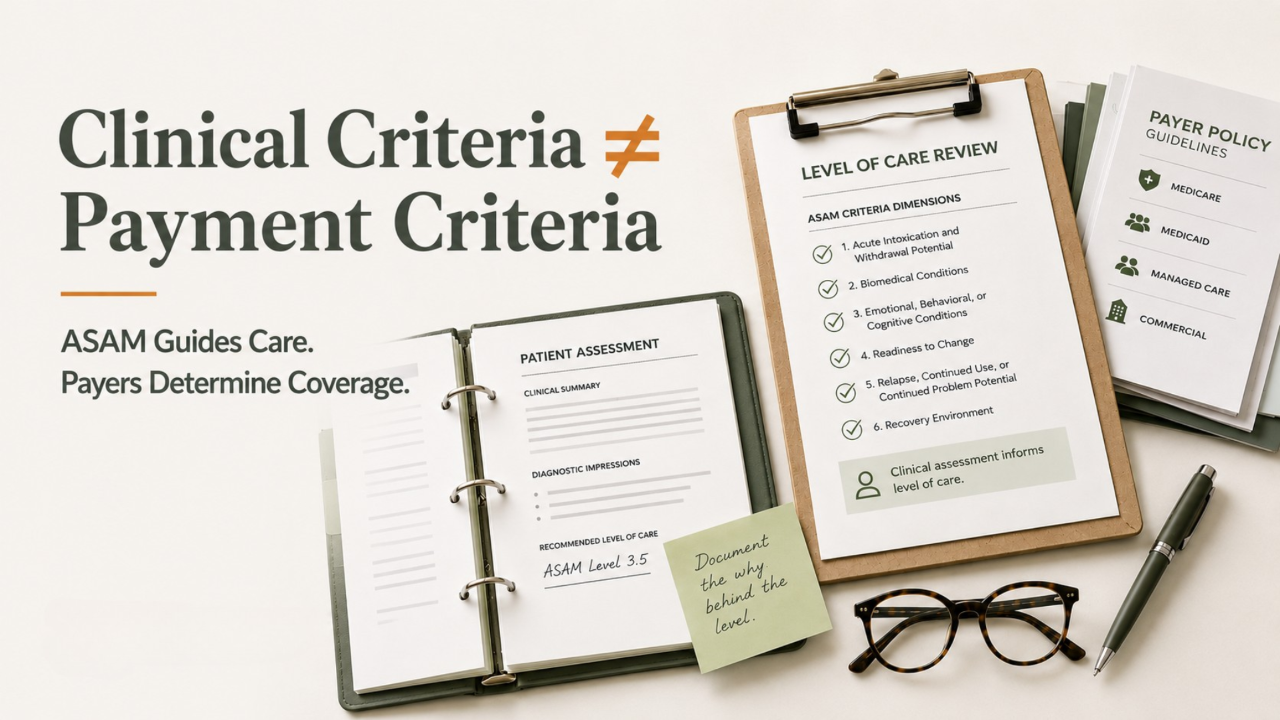
Getting paid for higher levels of SUD care: What the ASAM Criteria actually have to do with it
There is a lot of content in behavioral health about outpatient therapy, and telehealth billing. Those are real issues. They are not, however, where the reimbursement complexity gets the most dangerous when documenting and billing for SUD care.
Withdrawal management, residential treatment, PHP, and IOP all sit in a part of the continuum where the clinical criteria and the payment criteria operate on completely different logic. Understanding how those two things interact, and where they pull apart, is what separates organizations that survive audits from ones that don’t.
Start here: ASAM Criteria are clinical guidance, not a reimbursement rule
The levels of care most organizations reference today come from the Third Edition of the ASAM Criteria. The ASAM Criteria now have a Fourth Edition, but many states and payers are still working from the Third Edition. You may see commercial carriers implementing the Fourth Edition sooner.
ASAM Criteria were developed as a clinical framework to match patients to appropriate levels of care based on their clinical presentation across six dimensions: acute intoxication and withdrawal potential, biomedical conditions, emotional and behavioral conditions, readiness to change, relapse or continued use potential, and recovery environment.
That’s what they were built for. Clinicians making placement decisions.
Over time, payers—especially Medicaid, Medicaid managed care organizations, and commercial carriers—turned ASAM into the basis for prior authorization and continued-stay review. The clinical tool became the billing gatekeeper, which on the surface seems reasonable. However, because payers apply it differently, each with their own policies, their own timelines, and their own interpretation of what “meets criteria” looks like, the criteria now mean different things depending on who is paying the claim.
That is where most of the reimbursement problems start.. Not the criteria themselves. How they are being applied by payers who did not write them.`
The Service Lines
Before getting to the payer breakdown, here is a plain-language summary of some of the more widely used SUD levels of care under the ASAM Third Edition framework.
- Intensive Outpatient (IOP) – ASAM Level 2.1. A minimum of nine hours of structured treatment per week for adults. Patients are not residing in a facility. This level is used for patients who need more support than weekly outpatient therapy provides but can safely manage their symptoms in the community with that structure.
- Partial Hospitalization (PHP) – ASAM Level 2.5. Twenty or more hours of treatment per week. Often described as a day program. Patients return home or to sober living each evening. It sits between IOP and residential in intensity and is used for patients who need significant daily clinical structure but do not require overnight care.
- Clinically Managed High-Intensity Residential – ASAM Level 3.5. What most people mean when they say “rehab.” Twenty-four-hour structured care with a full clinical milieu. Used for patients who cannot safely stabilize at a lower level of care or at home.
- Medically Monitored Intensive Inpatient – ASAM Level 3.7. Adds physician or APRN oversight, with twenty-four-hour nursing for monitoring and medication management. Used heavily for withdrawal management and for patients who need a higher level of medical oversight than clinically managed residential can provide, but who do not require full hospital admission. In the community behavioral health world we often refer to this as inpatient detox even though it is a free-standing facility not a hospital delivering care.
- Medically Managed Intensive Inpatient – ASAM Level 4. Hospital-level care. Full physician management, around-the-clock nursing, for patients with severe medical or psychiatric instability alongside the SUD. This level is regulated and reimbursed more like an acute inpatient hospital stay.
A note about withdrawal management. Withdrawal management, sometimes called detox, is not a standalone ASAM level per se. It can occur across several levels depending on the patient’s medical needs. Ambulatory withdrawal management with monitoring sits at Level 2 WM for example. The medical complexity of withdrawal drives the level, and the level drives the reimbursement. Billing withdrawal management at a level that does not match the documented clinical acuity is one of the most common audit triggers that often leads to recoupment in this space.
How each major payer approaches these levels
The three payer types that cover most SUD care in the U.S. approach residential and intensive levels of care very differently. What works under one does not necessarily work under another, and organizations that treat all three the same way are setting themselves up for problems.
Medicare
Medicare covers IOP and PHP. Since January 2024 there is a formal IOP benefit under Part B, which was a meaningful expansion. Medicare also covers hospital-level inpatient care under Part A, including medically managed inpatient treatment at Level 4.
What Medicare generally does not cover is free-standing, non-hospital residential treatment. Residential services are largely outside the Medicare benefit package. For the many patients who clinically need residential care but have Medicare as their primary coverage, that middle of the continuum is generally not covered under Medicare. There is advocacy and pending legislation pushing to close that gap, but as of right now it is open. For more information on the bill reference: https://www.aging.senate.gov/imo/media/doc/residential_recovery_for_seniors_act.pdf
The practical impact for organizations: a Medicare beneficiary referred for residential SUD treatment is a coverage conversation that has to happen at admission, not a billing question to sort out later.
Medicaid
Medicaid is the largest single payer for SUD treatment in the country. It covers IOP, PHP, and residential care in most states. But residential coverage runs directly into a structural federal problem: the IMD exclusion.
Since 1965, federal Medicaid law has prohibited using federal funds for patients residing in an institution for mental disease, defined as a residential SUD or mental health facility with more than sixteen beds. That means a residential SUD program with more than sixteen beds cannot be reimbursed with federal Medicaid dollars unless the state has a Section 1115 SUD waiver from CMS. Those waivers have to be applied for, approved, and maintained, and they come with requirements, including that residential providers meet ASAM criteria standards and offer access to medication-assisted treatment.
The result is that in states without a waiver, Medicaid coverage for residential SUD care in larger facilities simply does not exist, regardless of clinical need. Organizations operating in those states need to know their state’s waiver status and understand what it means for their patient population and payer mix.
For Medicaid managed care organizations specifically, the added layer is that each MCO may, depending on their state Medicaid program, apply the ASAM criteria through its own prior authorization and continued stay policies. Same patient, same level of care, different MCO, different authorization outcome. That inconsistency is not accidental. It is a product of how the contracts are written and how broadly the MCOs have been permitted to define “medically necessary.”
Commercial Insurance
Commercial payers generally offer the broadest coverage for higher levels of SUD care, including residential treatment, and typically pay the highest rates. That does not make them straightforward.
Commercial plans use prior authorization and concurrent review aggressively at the higher levels of care. Authorization cycles for residential treatment are often as short as three to seven days, meaning continued stay has to be re-justified at a very tight pace using ASAM criteria language.
The Mental Health Parity and Addiction Equity Act (MHPAEA) is supposed to require that commercial payers apply utilization review to SUD care no more restrictively than they apply it to medical and surgical care. The 2024 federal MHPAEA rule has been placed on an enforcement pause after a legal challenge, and as of early 2026 the underlying statutory parity requirements still remain in effect.
The documentation problem that runs through all of this
Across all three payer types, the pattern in audits and post-payment reviews is the same. It is not that the clinical care was inappropriate. It is that the documentation does not prove it was appropriate.
Per diem billing at the residential levels bundles everything into a single daily rate. That rate stays authorized as long as the continued stay documentation supports ASAM criteria for that level. When it does not, when the chart shows the patient is doing well without showing why that patient still needs that level of care rather than stepping down, authorization stops or recoupment follows.
This is where the paid-versus-defensible problem becomes most visible. When residential care costs $500 to $1,000 or more per day, depending on payer and state, even a week of unsupported continued-stay documentation is not just a compliance risk it is a measurable recoupment exposure.
ASAM criteria were designed to support clinical placement decisions. Payers co-opted them to make authorization decisions. That means your clinical documentation has to speak both languages simultaneously: it has to tell a real clinical story and satisfy a prior authorization framework that your payer’s reviewer is measuring every few days. That is a documentation discipline challenge, not just a coding problem.
If you want help building that discipline into your organization’s workflow before an auditor at your payer surfaces it, reach out. That is the work we do.