
Paid vs Defensible Claim: There is a Difference.
Apr 29, 2026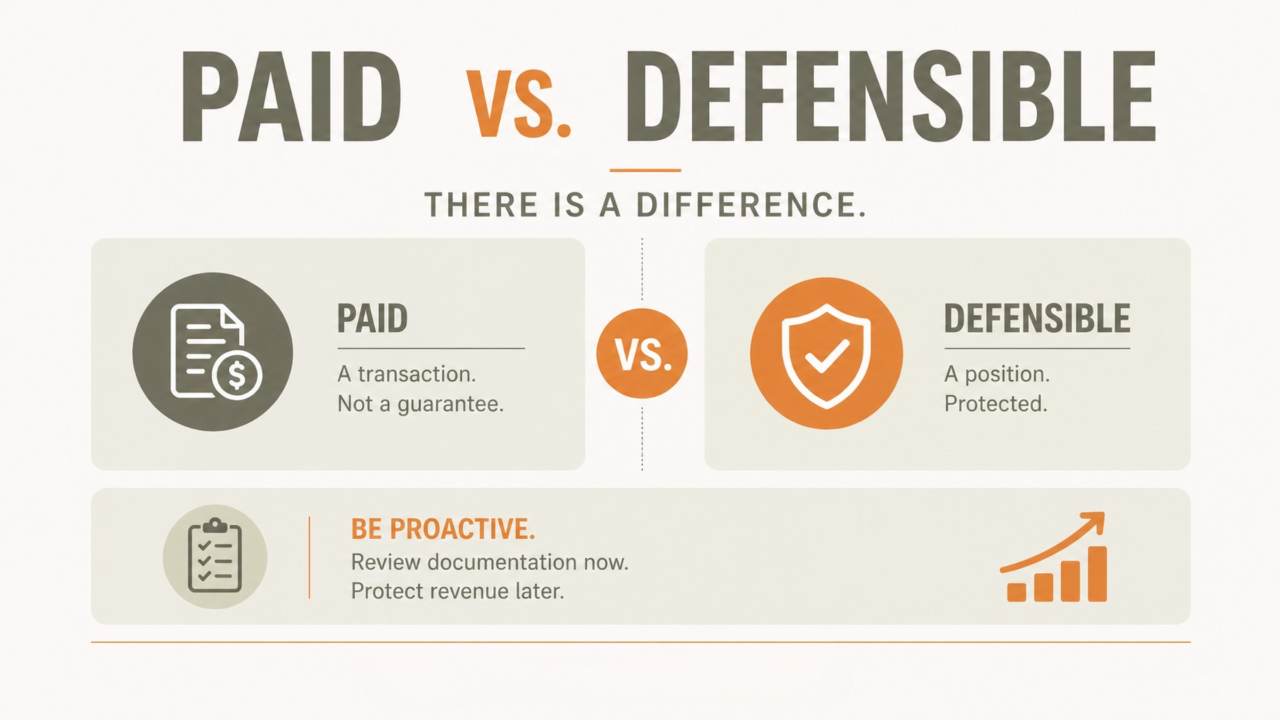
If a claim paid, it must be fine. That belief is one of the most expensive assumptions in healthcare billing. The reality is that payment is not validation. It is a transaction. And that transaction can be reversed, sometimes years after the fact.
Post-payment audits are not a new concept, but the frequency and reach of them have changed significantly. Payers are going back into paid claims, often 18 to 24 months after the fact, and recouping money based on documentation that did not meet their requirements at the time of service. The claim paid. The revenue is still at risk.
This is the shift that behavioral health organizations need to fully absorb: paid claims and defensible claims are not the same thing. And until that distinction is built into day-to-day operations, revenue will remain vulnerable.
Why Behavioral Health Is Particularly Exposed
Traditional medical services like a hypertension visit or a diabetes follow-up are billed within a framework that has clear, well-established documentation rules. The E/M code levels have defined requirements. Providers and coders know what the note has to contain. Its not an exact science; it has been one that has evolved but generally stood the test of time.
Behavioral health services do not always work that way. Services like Intensive Outpatient Programs (IOP), Partial Hospitalization Programs (PHP), and case management are delivered differently, documented differently, and held to documentation standards that are less standardized across payers. That variability creates risk.
What payers are finding, and what is driving a significant share of recoupments right now, is not that the care was inappropriate or that the wrong code was selected. It is that specific documentation elements required to support the code were absent from the record. The service may have been delivered correctly. The note did not prove it.
That is a technical miss, and it is entirely preventable. But it requires knowing in advance what each service requires in documentation, not discovering the gap during an audit.
Payment Is a Data Point, Not a Green Light
Payer systems process enormous volumes of claims. Adjudication happens quickly and is largely automated. A claim that does not trigger a pre-payment review will pay, and that payment means nothing about whether the documentation behind it would survive a review.
Post-payment audits operate on a different timeline and a different level of scrutiny. An auditor reviewing a sample of claims is looking at the actual documentation against the payer’s coverage policies, LCD guidelines, and service-specific requirements. What the adjudication system accepted and what a human auditor will accept are two different standards.
Organizations that have operated under the assumption that consistent payment means consistent compliance are often the ones most surprised by recoupment demands. The payment history provides no protection. The documentation does.
What Defensible Actually Means
A defensible claim is one where the documentation in the record can stand up to payer scrutiny independently, without the need for explanation, supplementation, or additional context. If an auditor pulls that claim today, the note supports the service billed. Period.
For behavioral health services, that means the documentation must address:
- Service-specific required elements: Each service type, including IOP, PHP, case management, and individual therapy, has documentation requirements that are either defined by payer policy or regulatory guidance. Those elements must be present in the note, not assumed.
- Treatment plan connection: Progress notes need to tie back to the treatment plan in a way that is visible and specific. Generic language and templated notes that do not reflect individual client progress are one of the most consistent documentation failures in audit findings.
- Diagnosis support across the full record: The diagnosis must be supported not just at intake, but throughout the longitudinal record. If the documentation does not continue to reflect and support the diagnosis, the services tied to it become harder to defend.
- Time and service delivery details: Depending on the service, documentation of time, setting, delivery method (particularly for telehealth), and who provided the service is required. Missing any of these creates exposure.
The Only Comfortable Position Is a Proactive One
There is no way to feel confident about reimbursement stability if the review process only happens when an audit arrives. By that point, the documentation cannot be changed, the money is potentially at risk, and the organization is on defense.
The most practical starting point is mapping each service line to its documentation requirements by payer. Not at a general level, at a specific, operational level. What does the payer require in the progress note for IOP? What elements must be documented for PHP to be defensible under a post-payment review? What does case management documentation need to include to meet the contract standard, not just the internal standard?
Once those requirements are defined, proactive internal review means regularly checking documentation against them on a consistent, recurring basis. Not once a year. Not when a denial pattern surfaces.
Proactive documentation review should answer:
- Does the note contain every element required by the payer for this specific service?
- Is the progress note specific to this individual for this encounter, not copied from a prior note?
- Does the note connect to the treatment plan in a way that is visible and individualized?
- Is the level of service billed consistent with what the documentation describes?
- Are there patterns of missing elements across providers, programs, or service lines?
When issues are identified internally, they can be corrected before they become audit findings. Staff can be retrained before a pattern solidifies. Workflows can be adjusted before the payer has already flagged the organization for review.
When staff understand what is required, not just what the EHR template prompts for, documentation quality changes. The goal is not perfection. The goal is awareness and a system that catches documentation gaps before the payer does.
Final Thought
Behavioral health providers work hard. Services are delivered. Claims are submitted. Money comes in. It is easy to read that cycle as confirmation that the system is working.
But payment is not the finish line. It is the beginning of a liability period. The only thing that protects that revenue if a payer comes back is documentation that can stand on its own, documentation that was right at the time it was written.
Paid is a transaction. Defensible is a position. Know the difference.