
The Hidden Cost of Being Out of Network
Mar 04, 2026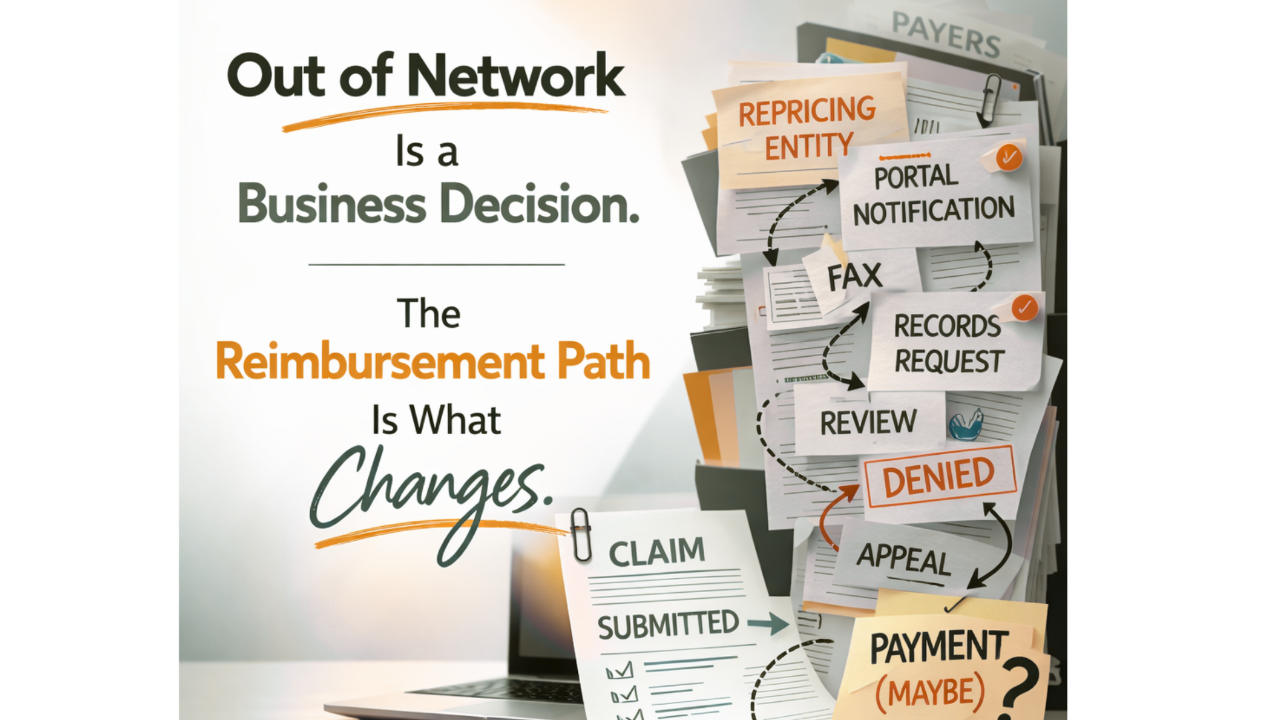
Providers have the right to choose whether they participate in insurance networks. That decision is not reckless, unethical, or patient adverse despite how it is sometimes portrayed.
Some providers go out of network because the contracted rates do not support the cost of care. Others do it because prior experiences with a payer were so operationally burdensome that staying in network became unsustainable. Either way, the quality of care delivered does not suddenly drop the moment a provider is no longer contracted.
But what does change dramatically is everything that happens after the claim is submitted.
Out of network providers are forced into a system that looks less like reimbursement and more like survival by negotiation. And much of that negotiation is not even with the insurance company itself.
The Third-Party Repricing Reality
Once a provider is out of network, claims are often routed through third party repricing entities rather than being adjudicated directly by the payer. Names that frequently surface in this space include Multiplan, now Claritev, and Zelis among others.
In theory, these entities exist to assist with determining reasonable reimbursement. In practice, they often function as gatekeepers introducing delays, pressure tactics, and unclear pricing logic that the provider has no contractual relationship with and very little ability to challenge.
Out-of-network practices routinely receive communications sometimes by fax, sometimes by portal stating that if the provider accepted a reduced amount within a very short window, payment would be released quickly. If not, payment could be delayed indefinitely or potentially not issued at all.
These communications frequently arrived late in the week, creating artificial urgency and forcing decisions to be made under pressure without full context or time to assess impact. That is not negotiation. It is leverage.
This Isn’t Just Provider Frustration Anymore
What is notable is that this experience is no longer confined to billing offices and back end conversations.
There is now active federal litigation examining whether third party repricing arrangements and shared pricing systems used by insurers unlawfully suppress out of network reimbursement. Courts have allowed these cases to proceed, signaling that the allegations are serious enough to warrant examination rather than dismissal.
I am not offering legal conclusions here. But it matters that what providers have described for years coordinated pricing, limited transparency, and constrained payment outcomes is now being scrutinized in the public record.
That should give anyone pause before dismissing provider concerns as isolated complaints.
Records Requests. The Other Silent Weapon.
Repricing is only part of the burden.
Out of network providers are also far more likely to face repeated and often unnecessary medical record requests even when no prior authorization was required and no specific documentation deficiency has been identified.
Again, this was routine when I was running billing operations for an out of network clinic in New York.
Records are requested on claim after claim sometimes more than once for the same service with little explanation and no clear standard for what would finally satisfy review. Out of network claims will be scrutinized until something can be found by the carrier that rarely makes sense for a denial.
When Technicalities Trump Reality
One denial still stands out to me because it perfectly captures how distorted this process can become.
A provider documented cholesterol in the medical record. The lab billed the appropriate cholesterol test code. The payer denied the claim not because the test was not performed and not because results were missing. The results were present. The denial occurred because the provider did not use the word “total” in the note in describing the cholesterol test.
The payer had full access to the lab results. They could see exactly what test was run and what values were obtained. Yet the claim was denied solely because the documentation language did not mirror the full descriptor of the CPT code.
That denial had nothing to do with patient care.
Nothing to do with fraud prevention.
Nothing to do with clinical ambiguity.
It was technical “exactness” being used as a blunt instrument. And out of network providers feel the impact of that far more often than their in network counterparts.
The Bigger Picture
When insurers rely heavily on third party repricers and aggressive post payment scrutiny, the result is not cost control. It is provider erosion.
Providers who choose to remain out of network are not opting out of accountability. They are opting out of contracts that do not reflect reality. But the current system punishes that choice by layering in barriers that make fair reimbursement unnecessarily difficult.
Even as this continues, we should expect to see more providers go out of network, not fewer. And with that comes a growing need to support them not just clinically but operationally as they navigate a reimbursement landscape that often feels stacked against them.
This is a conversation the industry needs to have honestly. Because being out of network should be a business decision, not a battle of endurance.
Sources and Further Reading
Reuters. U.S. judge rules health insurers, Multi Plan must face price fixing lawsuits. June 2025.
Reuters. U.S. Justice Department backs medical providers lawsuit over shared pricing systems. March 2025.
American Medical Association. Public statements and filings related to antitrust concerns involving third party repricing entities.